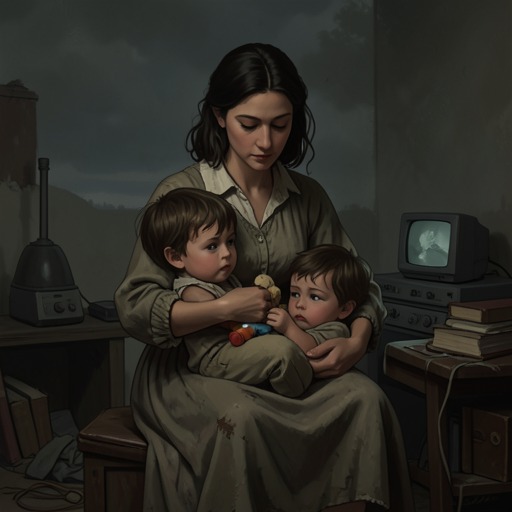
Cochin Harbor Terminus
The God of Small ThingsCochin Harbor Terminus is the station where Estha is sent away from Ammu and Rahel, and where a family decision becomes an irreversible-seeming parting. Its platform holds both the arrangements that make the separation possible and the physical instant when the train begins to carry Estha away from his mother; the station therefore marks not simply a point on a journey, but the scene of a rupture that shapes the family’s later life.
Setting and Departure
The station appears in the novel as a place of crowding, noise, and arrested darkness. At the platform, Ammu stands with her face turned up toward the train window, her skin made gray and wan by the neon light. Trains stand on either side, figured as long corks bottling up the darkness, while a hostling-jostling crowd presses around the family. Rahel is held by Ammu’s hand and stamps at the settled station-filth until Ammu tells her to stop. These details make the departure public and exposed, even as its emotional meaning belongs to the family alone.
The Madras Mail and the Flying Rani are named among the trains hemming in the platform. In the departure scene, the Madras Mail becomes the vehicle of separation: Estha sits alone at its barred window, with his trunk under the seat, his name on it, and his food packed beside him. A tiflin box contains tomato sandwiches; an Eagle flask sits on the folding table in front of him. These carefully identified belongings give the journey a child’s practical scale, set against the gravity of what is being done to him.
The Decision to Separate the Twins
The journey is arranged as part of the family’s decision that one twin may remain in Ayemenem, but not both. They are judged to be trouble together, and the decision is to separate them. Since Mr Kurien Maathen, described as a family friend, is already going to Madras and will escort Estha, Mammachi decides that another ticket need not be bought. Baba is buying a Madras-Calcutta ticket; Ammu is buying time, packing to leave and begin a new life in which she might afford to keep her children.
The practical logic of tickets, destinations, and an adult escort does not soften the choice. While packing Estha’s trunk and hold-all, Ammu whispers that perhaps those making the decision are right, and perhaps a boy does need a Baba. The scene places that doubt beside her effort to secure a life for her children: she is preparing to leave in order to keep them, even as the arrangement sends Estha away from her. Cochin Harbor Terminus is where these incompatible purposes converge in a single departure.
The Parting on the Platform
As the Madras Mail begins to move, Estha’s pupils dilate. His nails dig into Ammu’s hand while she walks along the platform; as the train gathers speed, her walk becomes a run. The departure is rendered through contact and motion rather than explanation. The hand links mother and child, while the moving train steadily makes that link harder to maintain.
Ammu tells Estha that she will come for him soon and calls him her baby and sweetheart. Estha cries, “Ammu!” as she disengages her hand, prising his fingers loose one by one. The gradual release turns the station’s separation into a sequence of small physical acts: the train accelerates, Ammu runs, and each finger is separated from her hand. The scene’s emotional force rests in the contrast between the promise of a future reunion and the immediate, deliberate breaking of contact.
Recurrence and Significance
The station returns in the novel’s account of Estha as an adult. In the dark, in a clean room in the dirty Ayemenem House, he sits upright on his bed with his shoulders squared and his hands in his lap, as if awaiting inspection or arrest. The return to Cochin Harbor Terminus recalls the earlier departure without making it a completed passage into a new life: the adult Estha is again defined by stillness, while the remembered child was carried away by a train.
At the station, Estha is alone at the barred window, with his belongings arranged within reach. The image of the barred window joins the practical fact of travel to the constraint of the separation. The platform’s crowd, station light, trains, luggage, and clasped hands give the event a sharply concrete setting; their recurrence makes the station a narrative threshold where a decision made by adults becomes an enduring experience for a child. Its decisive significance lies in that transformation: departure is organized as logistics, but remembered as the moment Ammu’s hand is prised from Estha’s, one finger at a time.